Subheading
Opening statement
Paragraph: THis text
Subheading:
Adding an image:
Adding a file:
Adding an accordion:
Adding an open all accordion button:
Adding an accordion within an accordion:
Adding Files:
Adding Images:

Making Tables
-Adjusting column width
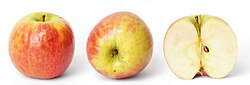 | Apple: An apple is a round, edible fruit produced by an apple tree (Malus spp.). Fruit trees of the orchard or domestic apple (Malus domestica), the most widely grown in the genus, are cultivated worldwide. The tree originated in Central Asia, where its wild ancestor, Malus sieversii, is still found. Apples have been grown for thousands of years in Eurasia before they were introduced to North America by European colonists. Apples have cultural significance in many mythologies (including Norse and Greek) and religions (such as Christianity in Europe). |
 | Banana: A banana is an elongated, edible fruit—botanically a berry[1]—produced by several kinds of large treelike herbaceous flowering plants in the genus Musa. In some countries, cooking bananas are called plantains, distinguishing them from dessert bananas. The fruit is variable in size, color and firmness, but is usually elongated and curved, with soft flesh rich in starch covered with a peel, which may have a variety of colors when ripe. It grows upward in clusters near the top of the plant. Almost all modern edible seedless (parthenocarp) cultivated bananas come from two wild species – Musa acuminata and Musa balbisiana, or hybrids of them. |
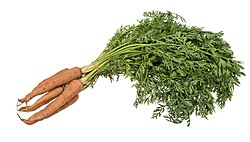 | Carrot: The carrot (Daucus carota subsp. sativus) is a root vegetable, typically orange in colour, though heirloom variants including purple, black, red, white, and yellow cultivars exist, all of which are domesticated forms of the wild carrot, Daucus carota, native to Europe and Southwestern Asia. The plant probably originated in Iran and was originally cultivated for its leaves and seeds. |
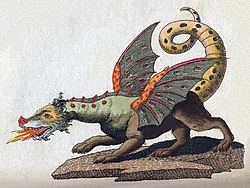 | Dragon: A dragon is a magical legendary creature that appears in the folklore of multiple cultures worldwide. Beliefs about dragons vary considerably through regions, but dragons in Western cultures since the High Middle Ages have often been depicted as winged, horned, and capable of breathing fire. Dragons in eastern cultures are usually depicted as wingless, four-legged, serpentine creatures with above-average intelligence. Commonalities between dragons' traits are often a hybridization of reptilian, mammalian, and avian features. |

| The Arecaceae (/ˌærəˈkeɪsi.iː, -ˌaɪ/) is a family of perennial, flowering plants in the monocot order Arecales. Their growth form can be climbers, shrubs, tree-like and stemless plants, all commonly known as palms. Those having a tree-like form are colloquially called palm trees.[4] Currently, 181 genera with around 2,600 species are known,[5][6] most of which are restricted to tropical and subtropical climates. Most palms are distinguished by their large, compound, evergreen leaves, known as fronds, arranged at the top of an unbranched stem, except for the Hyphaene genus, who has branched palms. However, palms exhibit an enormous diversity in physical characteristics and inhabit nearly every type of habitat within their range, from rainforests to deserts. Palms are among the best known and most extensively cultivated plant families. They have been important to humans throughout much of history, especially in regions like the Middle East and North Africa. A wide range of common products and foods are derived from palms. In contemporary times, palms are also widely used in landscaping. In many historical cultures, because of their importance as food, palms were symbols for such ideas as victory, peace, and fertility. |

| Alaska (/əˈlæskə/ ⓘ ə-LASS-kə) is a non-contiguous U.S. state on the northwest extremity of North America. Part of the Western United States region, it is one of the two non-contiguous U.S. states, alongside Hawaii. Alaska is also considered to be the northernmost, westernmost, and easternmost (the Aleutian Islands cross the 180th meridian into the eastern hemisphere) state in the United States. It borders the Canadian territory of Yukon and the province of British Columbia to the east. It shares a western maritime border, in the Bering Strait, with Russia's Chukotka Autonomous Okrug. The Chukchi and Beaufort Seas of the Arctic Ocean lie to the north, and the Pacific Ocean lies to the south. Technically, it is a semi-exclave of the U.S., and is the largest exclave in the world. Alaska is the largest U.S. state by area, comprising more total area than the following three largest states of Texas, California, and Montana combined, and is the seventh-largest subnational division in the world. It is the third-least populous and most sparsely populated U.S. state; however, with a population of 740,133 as of 2024, it is the most populous territory in North America located mostly north of the 60th parallel, with more than quadruple the combined populations of Northern Canada and Greenland.[6] The state contains the four largest cities in the United States by area, including the state capital of Juneau. The state's most populous city is Anchorage, and approximately half of Alaska's residents live within its metropolitan area. Indigenous people have lived in Alaska for thousands of years, and it is widely believed that the region served as the entry point for the initial settlement of North America by way of the Bering land bridge. The Russian Empire was the first to actively colonize the area beginning in the 18th century, eventually establishing Russian America, which spanned most of the current state and promoted and maintained a native Alaskan Creole population.[7] The expense and logistical difficulty of maintaining this distant possession prompted its sale to the U.S. in 1867 for US$7.2 million (equivalent to $162 million in 2024). The area went through several administrative changes before becoming organized as a territory on May 11, 1912. It was admitted as the 49th state of the U.S. on January 3, 1959.[8] |

| In criminal law, in certain jurisdictions, criminal prosecutions are brought in the name of the People. Several U.S. states, including California, Illinois, and New York, use this style.[6] Citations outside the jurisdictions in question usually substitute the name of the state for the words "the People" in the case captions.[7] Four states — Massachusetts, Virginia, Pennsylvania, and Kentucky — refer to themselves as the Commonwealth in case captions and legal process. Other states, such as Indiana, typically refer to themselves as the State in case captions and legal process. Outside the United States, criminal trials in Ireland and the Philippines are prosecuted in the name of the people of their respective states. The political theory underlying this format is that criminal prosecutions are brought in the name of the sovereign; thus, in these U.S. states, the "people" are judged to be the sovereign, even as in the United Kingdom and other dependencies of the British Crown, criminal prosecutions are typically brought in the name of the Crown. "The people" identifies the entire body of the citizens of a jurisdiction invested with political power or gathered for political purposes.[8] |